Time Travel Research Center © 2005 Cetin BAL - GSM:+90 05366063183 - Turkey/Denizli
Apollo Expeditions to the Moon
CHAPTER 11
What was the Apollo Program?
The Apollo Program was an American lunar-space program designed to land an astronaut on the moon and return him safely to earth, as well as to overtake the former Soviet Union in the race to dominate space exploration. The program was conducted between May 1961 and December 1972 by the National Aeronautics and Space Administration (NASA). The program was successful in landing Neil Armstrong, the first person to walk on the moon, and 11 other astronauts on the moon. The program included 12 manned missions: 2 into earth orbit (Apollo 7 and 9); 2 2 into lunar orbit (Apollo 8 and 10); 3 lunar landing missions (Apollo 11, 12, and 14); and 3 lunar exploration missions (Apollo 15, 16, and 17). The exploration missions involved extended stays on the moon's surface and more in depth scientific exploration. One mission was lost during a test on the launch pad (Apollo 1), and one mission returned to the earth before making a scheduled lunar landing (Apollo 13).

Apollo Spacecraft and Supporting Systems
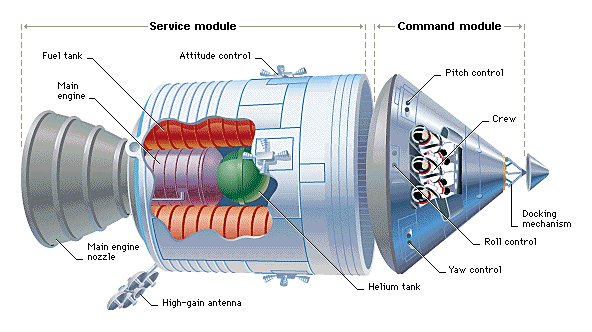
Each manned Apollo mission consisted of two spacecraft: the Command and Service Module (CSM) designed for orbital and re-entry operations; and the Lunar Module (LM) designed for lunar landing and surface operations. The exceptions were Apollo 7 and 8, which flew the CSM only. The CSM comprised the command module, with the crew compartment and the re-entry heat shield, and the service module, with the major support systems and consumables (such as propulsion systems, electrical power, food, and water). The LM comprised the descent stage, for landing and delivery of the lunar-surface equipment, and the ascent stage, with the crew compartment and independent systems for ascent from the moon's surface and rendezvous with the CSM.
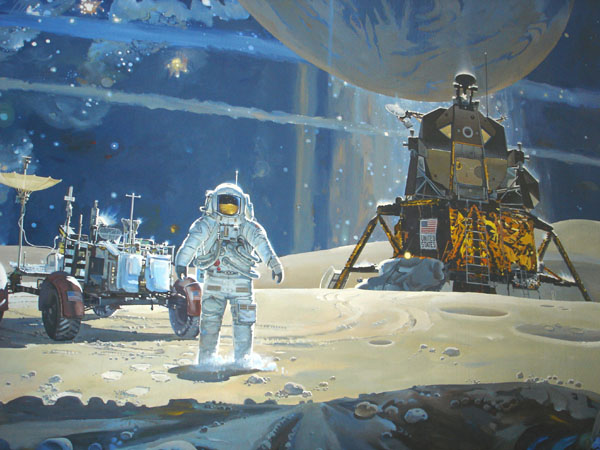
Apollo missions used a crew of three astronauts. During launch, all three astronauts were in the CSM. After leaving the earth's orbit, the crew separated the CSM from the LM and the part of the launch vehicle surrounding the LM, then maneuvered the CSM to dock with the LM to extract the LM from the launch vehicle so that the crew could transfer between the two craft. After three days transit time to the moon, the CSM and LM entered into lunar orbit. Two astronauts then transferred to the LM, separated from the CSM, and descended to the lunar surface. The third astronaut continued to operate the CSM in lunar orbit.
Launch System
The launch vehicle used for lunar missions was the Saturn V rocket designed specifically for Apollo craft. The Saturn launch vehicle family and the design of its support facilities were derived from technology developed by rocket engineer Wernher von Braun and his team at Peenemünde, Germany, during World War II. Von Braun brought his work and his team to the United States in 1945. The Saturn V consisted of three stages used in sequence to boost spacecraft into the earth's orbit and on toward the moon. The CSM and LM were mounted separately on top of the Saturn rocket system. At liftoff, the entire launch vehicle was 109 m (363 ft) high and it weighed 2.8 million kg (6.3 million lbs). The five Saturn first stage engines generated 3.5 million kg (7.7 million lb) of thrust. During the Apollo Program, 12 Saturn V rockets were launched from the Kennedy Space Center at Cape Canaveral, Florida, and all were successful.
Apollo Test Missions
A total of 16 unmanned Apollo missions were flown between October 1960 and April 1968. The objectives of these missions were to test the Saturn rocket launch system and certain systems of the CSM and the LM. The launch vehicle systems and the CSM abort system were tested in ten missions. Launch vehicle/spacecraft compatibility and the CSM heat shield were tested in four missions. The Saturn launch vehicle for the complete lunar landing configuration was tested by launching CSM and LM test vehicles into very high earth orbit paths.
Command and Service Module Diagram
Trip to the Moon
