Time Travel Research Center © 2005 Cetin BAL - GSM:+90 05366063183 - Turkey/Denizli
Apollo Expeditions to the Moon
CHAPTER 10
Apollo 11
On July 16, 1969, Apollo 11, the first lunar landing flight, was launched from Kennedy Space Center, Florida, before an onsite audience of over one million people. The mission Commander was Neil A. Armstrong, the Command Module Pilot was Michael Collins, and the Lunar Module Pilot was Edwin E. Aldrin, Jr.
The lunar landing was achieved by a method established in July of 1962. The method ultimately chosen, demonstrated as feasible by the Apollo 10 mission, was a lunar orbit rendezvous. This technique met the constraints of time, funds, safety, and technology. The scheme was recommended to NASA management by John C. Houbolt, an aeronautical engineer at the NASA Langley Research Center. In Houbolt's scheme, a Saturn V rocket would launch the Apollo craft, a three-man crew, and a lunar landing craft on a lunar orbital course. Once in orbit, two men would transfer to the lunar landing spacecraft, undock from the mother ship, and descend to the lunar surface. After the lunar visit, the crew would launch and rendezvous with the Command ship in lunar orbit, leave the landing vehicle in orbit, and return to Earth. The selection of the method for accomplishing the lunar landing was of great importance for the design of the spacecraft and the launch vehicle. Lunar orbit rendezvous was ultimately selected based on a tradeoff which considered launch weights and other operational considerations.
Three days after the launch to the moon, the Apollo 11 spacecraft was slowed by the Service Module propulsion system from a velocity of 10139 km/hr (6300 mph) to 6437 km/hr (4000 mph). On Saturday, July 19, 1969, the spacecraft achieved lunar orbital insertion. The orbit ranged from 86.6 by 105.7 km (53.8 by 65.7 miles) from the lunar surface. On Sunday, July 20th, with Michael Collins remaining behind in the Command Module, Columbia, Astronauts Armstrong and Aldrin entered the Lunar Module, Eagle. On the 13th lunar orbit, the spacecraft separated and the Lunar Module descent engine was fired. Astronaut Armstrong used the manual control mode to land the craft, He had realized that the Sea of Tranquility was strewn with boulders, and he [29] wished to place the spacecraft down in a safe attitude. Over 500 million people beard the first words from the moon, "Contact light. Okay, engine stopped...Houston, Tranquility Base here. The Eagle has landed " Six hours after the successful landing, Astronaut Armstrong set foot on the lunar surface. Twenty minutes later, he was followed by Astronaut Aldrin (figure 11).
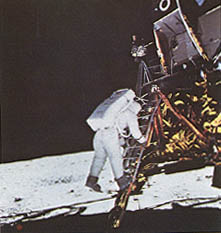
Figure 11. Astronaut Edwin E. Aldrin, Jr., Apollo 11 Lunar Module Pilot, stepping onto the lunar surface.
The astronauts quickly adapted to movement in lunar gravity, adopting a loping gait, a kind of kangaroo hop, as the most efficient for negotiating the lunar surface. They collected approximately 21 kg (46 lb) of rock and soil samples and set up the Apollo Early Surface Experiment Package (ESEP). The scientific payload consisted of a passive seismometer, a direct Earth-moon communications link, a solar wind experiment designed to isolate exotic gases in the solar wind, such as argon and krypton, for return to Earth for analysis; and an array of optical reflectors serving as targets for laser pointing systems on Earth, with the objective of more precisely measuring the distance between the Earth and the moon. After two and one-half hours of work on the lunar surface, the astronauts returned to the Lunar Module. Several hours later, the Lunar Module ascent stage was launched; it docked about three and one-half hours afterwards with the Command Module. During the return flight to Earth, the crew vacuum cleaned their clothing and equipment and took numerous precautions as part of a quarantine program to avoid carrying back to Earth any possible contamination from the moon. On Thursday, [30] July 24, after an eight-day mission, the crew splashed down in the Pacific Ocean. They donned biological isolation garments and were recovered by helicopter and transferred to the recovery ship USS Hornet where they were placed in a Mobile Quarantine Facility, a trailer modified for the purpose. They traveled in the MQF to the Lunar Receiving Laboratory in Houston, where they were kept in isolation for 21 days after lift-off from the lunar surface to preclude the possibility of contaminating the Earth with lunar organisms or material. Extensive medical and biological tests determined that no harmful organisms were present in any of the materials returned from the moon, and quarantine was terminated.
The materials returned from the 1 533 225 km (952 700 mile) journey to the moon and back were distributed to 144 scientists throughout the world. Figure 12 illustrates material from lunar rock. Among the scientific findings reported was the fact that the moon is approximately 4.6 billion years old.** The presence of minute deposits of gold , silver, and rubies in the lunar rilles was established, and evidence was found indicating that there were lava flows on the moon at one time. Additionally, three new mineral elements were discovered in the Apollo 11 samples analysis.
Artists concept of Apollo 11 Lunar Module ascent stage launched from moon
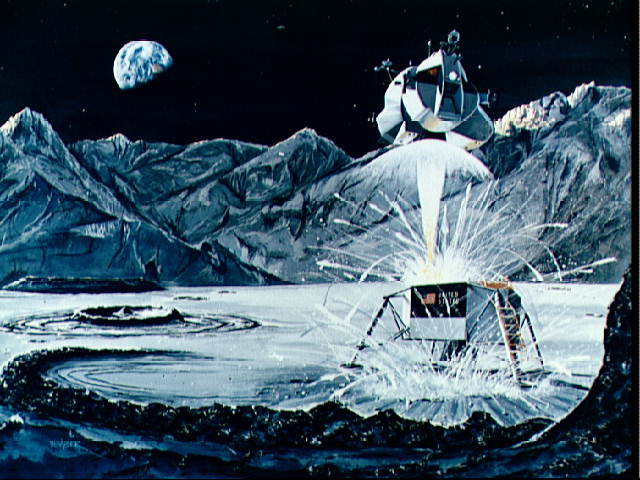
| Description: Rocketdyne artist's concept depicting the firing of the ascent engine as the Apollo 11 Lunar Module Ascent stage is launched from the surface of the moon. The descent stage serves as a launch base and remains on the lunar surface. | ||
| NASA Photo ID: S69-39335 | ||
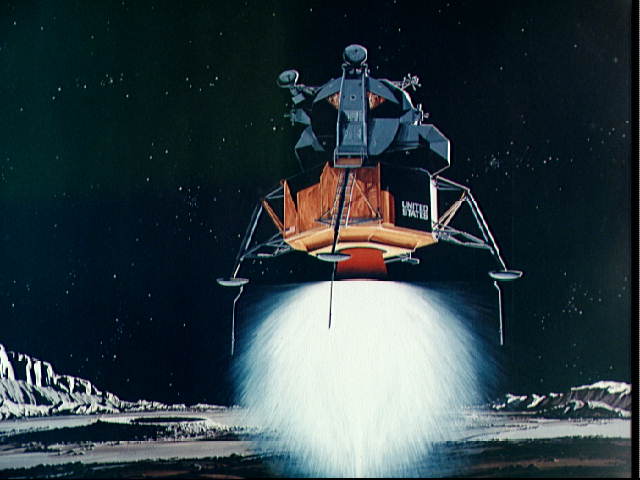
| Description: TRW Inc. artist's concept depicting the Apollo 11 Lunar Module descending to the surface of the moon. | ||
| NASA Photo ID: S69-39011 | ||