| |
Time Travel Research Center © 2005 Cetin
BAL - GSM:+90 05366063183 - Turkey/Denizli
Apollo Expeditions to the Moon
CHAPTER 8
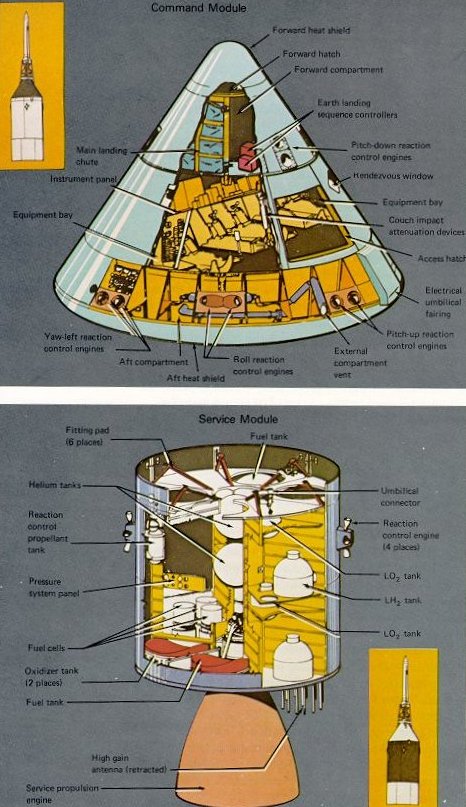
Above: Looking like a huge toy top the conical command
module was crammed with some of the most complex equipment ever sent
into space. The three astronaut couches were surrounded by instrument
panels, navigation gear, radios, life-support systems, and small engines
to keep it stable during reentry. The entire cone, 11 feet long and 13
feet in diameter, was protected by a charring heat shield. The 6.5-ton
CM was all that was finally left of the 3000-ton Saturn V stack that
lifted oft on the journey to the Moon.
Below: Packed with plumbing and tanks, the service module was the CM's
constant companion until just before reentry. So all components not
needed during the last few minutes of flight, and therefore requiring no
protection against reentry heat, were transported in this module. It
carried oxygen for most of the trip; fuel cells to generate electricity
(along with the oxygen and hydrogen to run them); small engines to
control pitch, roll, and yaw; and a large engine to propel the
spacecraft into -and out of- lunar orbit. |
| |
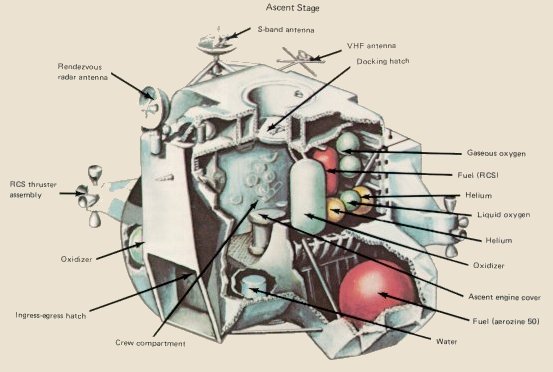
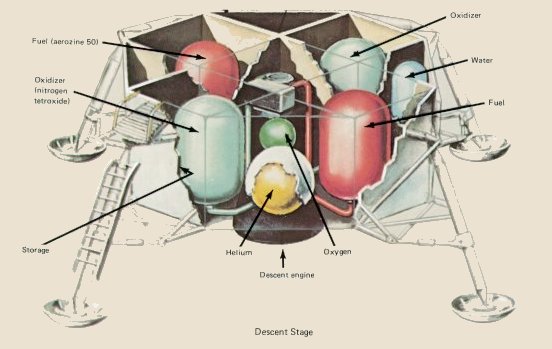
| The lunar module was also a two-part
spacecraft. Its lower or descent stage had the landing gear and engines
and fuel needed for the landing. When the LM blasted off the Moon, the
descent stage served as the launching pad for its companion ascent stage,
which was also home for the two explorers on the surface. In function if
not in looks the LM was like the CM, full of gear to communicate,
navigate, and rendezvous. But it also had its own propulsion system, an
engine to lift it off the Moon and send it on a course toward the
command module orbiting above. |
| |
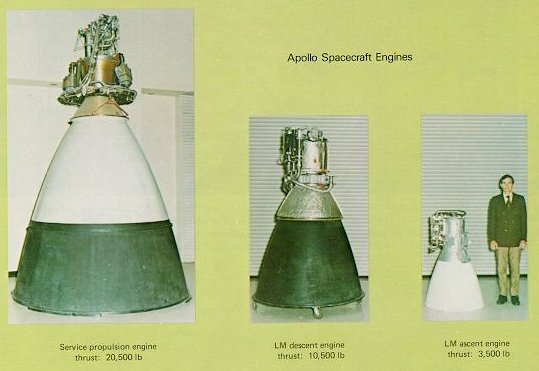
| Similar in shape but not size were the
three big engines aboard Apollo spacecraft. Two of them had no backup,
so they were designed to be the most reliable engines ever built. lf the
service-propulsion engine failed in lunar orbit, three astronauts would
be unable to return home; if the ascent engine failed on the Moon, it
would leave two explorers stranded. (A descent-engine failure would not
be as critical, because the ascent engine might be used to save the crew
members.) |
|
|