


1. Synchronization by Einstein:
Suppose, we have a system, where there are two clocks A and B placed at a distance Lo between them (Fig. 9). There is a source in a point O at distance of Lo/2, with which help we will perform synchronization of the clocks. The method of synchronization is essentially simple and boils down to triggering the clocks by means of a signal from the source O. Let us consider two cases: a) the system is resting in the ether; b) the system moves with a velocity V.
a) The system is resting
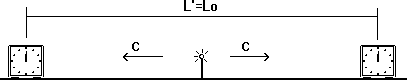
Fig. 9. Scheme of synchronization for zero velocity.
In this case, we do not have any objections against the chosen method - after starting, the clocks will really go synchronously and indicate the same time. Now, let us describe the experiment which we will carry out for V>0.
After the procedure of synchronization we need to measure the light velocity in one direction. This is the reason, why synchronization is necessary, because we intend to determine the time of passage of a light signal first from A to B by the clock B, and then from B to A by the clock A.

In the case just having been considered, nobody would have any objections against equation
.
b) The system is moving in the ether with velocity V

Fig. 10. Scheme of synchronization for a system that is moving and changing its dimensions.
In a system moving with velocity V>0
, physical distance between the clocks changes and becomes equal to

Speeds of the synchronizing signal from O to B and from O to A are

It is obvious, that times of the signal passages are also different. The synchronizing signal reaches clock A for
and clock B for
.
So, a situation arises, where we have a situation where the clocks are known to be mismatching where the difference value is equal to

This means, that now, if we measure the time of light passage from A to B by means of clock B, then the value of the error is equal to Dt. The same occurs, if we measure by the clock A time of light passage from B to A. Let us perform a calculation:
True time of signal passage from A to B:
True time of signal passage from B to A:
If we make corrections for the clock mismatching, then we obtain different results:

Thus,
. This is it, that leads to the conclusion: c = const.
Analysis of the obtained results directly indicates that the Einstein method always leads to a false result, precisely because of mis-synchronization of the clocks used in the experiment.
In this connection, nothing is strange in that the group of repudiating ether scientists, being unaware of the physical dimension contraction and having accepted the Einstein method of synchronization, always will come to the conclusion of the independence of light speed upon the motion of a system.
We, in contrast, being guided by the ether concept, have revealed the mechanism leading to the conceptual error and have shown a reason, how the conclusions of STR come naturally.
Page 12 of 26



