



Standing Wave As a Standard of Length
A question of creating universal units of measurement was posited as long ago as in the XVII century, but a decisive step to introduce the universal (metric) system was made only after the Great French Revolution. The National Assembly of France passed a resolution about a necessity to develop an international system of units.
Utilizing three natural units was discussed:
1) length of a pendulum whose oscillation period is 1 second (oscillation period of a simple pendulum depends only on its length);
2) length of one quarter of the Earth equator;
3) length of one quarter of the Earth meridional circle.
As a result of the long and intricate work involved, the invariable standard of length was developed and a platinum point measure was manufactured.
In the course of progress in measuring techniques, the meter standard appeared to be insufficiently precise and, as a point measure, often inefficient.
By the time of the holding of the First General Conference on the metric system (1889, the accepted standard was the meter), A. Michelson and E. Morley had shown that the meter unit can be compared with the wave length of light irradiation of certain frequency by means of the interferometer.
So, interferometry became the basis for the realization of a length unit, and, what is more, development of stable highly coherent light sources let it become the most precise technique.
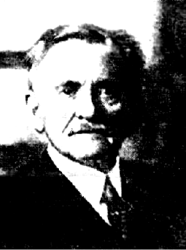
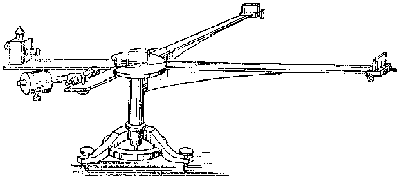
A. Michelson and his interferometer
But this story has a small and at first sight imperceptible detail: talking about the number of wave lengths fitting to one meter of the length standard, we ignore or, more precisely, forget, that we have to deal with a number of standing waves, which, as it succeeded to show, is not the same.
To understand this small but principle matter, it is necessary to analyze the wave processes taking place in interferometer sections between the translucent plate and the mirrors. Such an analysis was first performed in 1981 and led to discovery of a previously unknown phenomenon which was named “standing wave compression”.

Page 3 of 26